
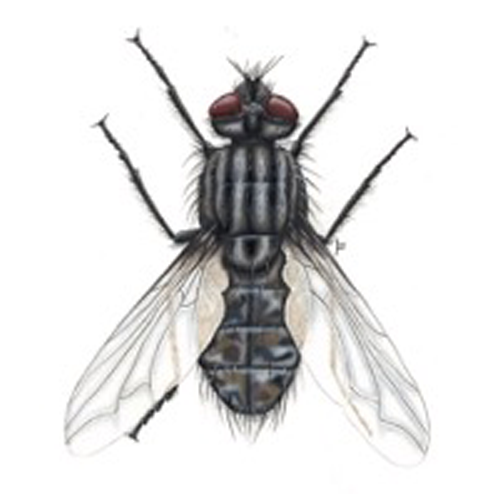
FFs are medium to large (10-14 mm), with red eyes, a dull gray body, and a distinct checkerboard pattern on the abdomen. FF is often mistaken for House fly but can be identified by three black thoracic stripes. Typical flight speed is up to 7 km/h (4.3 mph), with a slow, direct pattern. FF is larviparous (birth live maggots rather than placing eggs), which allows rapid colonization of decaying material.
FFs are important in clinical and forensic entomology (study of insects in medicine and legal investigations or medicolegal). FF may cause facultative myiasis (accidental infestation of live tissue, especially wounds) and can vector pathogens like Salmonella, E. coli, and Clostridium spp. FF plays a role in estimating the postmortem interval (PMI-time since death) by appearing at remains in predictable developmental stages.
| Trait | Description |
| Size | 10-14 mm or 0.40 to 0.55 in |
| Color | Gray-black body with checkerboard abdomen |
| Flight | Slow, direct (up to 7 km/h or 4.3 mph) |
| Activity | Diurnal (day-active) |
| Season | Spring through fall, peak in heat |
| Reproduction | Births live larvae (larviparous) |
| Risk | Hygiene & medical relevance |
FF is a decomposer, helping recycle nutrients by breaking down decaying organic matter. FF is used as a bioindicator (species that signal ecosystem health) during ecological monitoring of decay stages.
| SAFER | Impact |
| S-Safety | Vectors pathogens and may contaminate food via regurgitation, feces, and bodily grooming contact as well as cause facultative myiasis in wounds |
| A-Audit risk | Presence may impact inspections and corrective actions |
| F-Financial loss | May cause product contamination resulting in disposal, lost revenue, and penalties |
| E-Exposure (Brand) | Damages customer trust and online brand reputation (especially in healthcare environments) |
| R-Regulatory | Violates food safety regulations and third-party audit standards in critical areas |
FF pressure signals active putrefaction and sanitation failure (a single FF sighting can indicate a cryptic contamination source, which risks contamination, brand harm, and non-compliance).
FFs are rapid colonizers of decomposing masses and can appear indoors within hours of a sanitation lapse. Fly species presence may result from exploitable resource sites in and around a facility’s legacy equipment and/or infrastructural decay—further indicating declining facility health.
In the postmortem interval (PMI) or time since death, FF is often the first in time of arrival (TOA) or order of succession of insects to colonize decomposing remains. Entomologists use meteorological data, FF presence, and life stage to help determine time of death (TOD) in forensic cases.
"*" indicates required fields


Mon - Fri : 8 AM - 5 PM | EST