
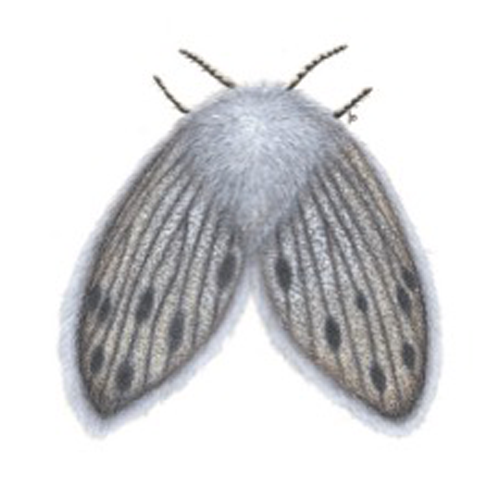
MFs are small, dark gray to brown flies (2 to 5 mm) with a characteristic moth-like, fuzzy appearance. Adults prefer to hop or make short fluttering flights.
Estimated time sequence for fly surface behavior.
| Behavior | Estimated Time | Notes |
| Attraction (approach) | 1-5 seconds | Oriented to drain and sewage volatiles and wet organic odors |
| Landing | Instantaneous | Often lands on vertical surfaces near moisture |
| Grooming | 2-6 seconds | Cleans antennae, eyes, body, legs, and wings; shedding particulates |
| Salivation (extraoral digestion) | 1-3 seconds | Pathogen containing saliva expressed before probing/feeding on residues |
| Defecation | 1-2 seconds | Micro-droplets may occur during/after feeding |
| Take-off | <1 second | Short flutter to nearby surface; limited sustained flight |
Primarily a nuisance, MFs can transfer opportunistic pathogens from drains, and other contaminated sites, to nearby surfaces. Indoor sudden emergences are biological indicators of drainage, waste, and vent (DWV) failures, dry drain traps, or cryptic moisture reservoirs that require corrective action.
| Trait | Description |
| Size | 2–5 mm (0.08–0.20 in) |
| Color | Dark gray to brown; fuzzy body and wings |
| Flight | Weak, short fluttering; mostly hops between nearby surfaces |
| Activity | Crepuscular, nocturnal |
| Season | Year-round indoors (persistent resource sites) |
| Reproduction | Places eggs (oviparous) |
| Risk | Biological indicator of poor sanitation; potential mechanical vector; nuisance |
MFs accelerate the decomposition of organic matter by grazing on microbial bio-films and play a role in nutrient recycling. In and around structures, MFs indicate moisture intrusion and biofilm accumulations.
| SAFER | Impact |
| S-Safety | May transfer patogens from drains to food-contact areas |
| A-Audit risk | Indicates inadequate drain maintenance, triggering audit observations |
| F-Financial loss | Emergency sanitation can incur significant costs |
| E-Exposure (Brand) | Moth-like aesthetic nuisance is distinctly noticeable to structural inhabitants |
| R-Regulatory | Presence violates sanitation protocols |
MF presence signals poor drain hygiene and possible infrastructural failure.
Reproduces within organic build-up layers inside drain structures. Fly species presence may result from exploitable resource sites in and around a facility’s legacy equipment and/or infrastructural decay—further indicating declining facility health.
Cuticular hydrophobicity and biofilm tolerance. Adult MFs are covered with dense, hydrophobic microtrichia (tiny hairs) that repel water, allowing survival in splash zones and humid microclimates without becoming saturated. Larvae possess posterior spiracles that extend to the surface of biofilm or sludge, functioning like snorkels for gas exchange in low-oxygen conditions. This dual adaptation lets the species exploit deep, anaerobic biofilms that other flies cannot colonize. Studies have documented C. albipunctata reproduction within hospital drains, where larvae can survive exposure to product interventions by retreating deep into biofilms.

"*" indicates required fields


Mon - Fri : 8 AM - 5 PM | EST