
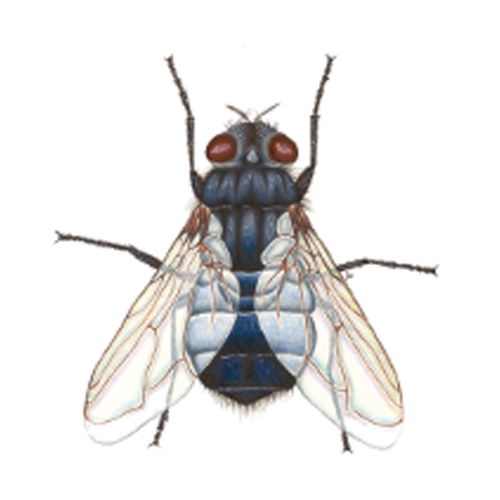
Blow and Bottle flies are medium to large (8-14 mm). Thorax and abdomen present as an iridescent metallic coloration. Adult females are oviparous, placing eggs in decomposing tissue, where larvae emerge and feed. With a wingspan of 18-20 mm, flight speeds are 7 to 11 km/h or 4.3 to 6.8 mph (brief bursts >13 km/h or 8 mph), enabling efficient sensory detection and fast, direct flight paths. Flight is loud and direct as these species are often among the first in the order of succession to arrive at the postmortem interval.
Blow and Bottle flies are medically significant in public health as well as forensic entomology. These species may cause facultative myiasis in animals and humans, particularly in neglected wounds or pressure ulcers (decubitus ulcers).
Blow and Bottle flies are vectors of pathogens including Salmonella, E. coli, and Clostridium. As forensically significant fly species Blow and Bottle flies are key indicators in estimating the postmortem interval (PMI) by appearing at remains in predictable developmental stages.
| Trait | Description |
| Size | 8-14 mm (0.31 to 0.55 in) |
| Color | Iridescent metallic coloration |
| Flight | Loud, fast, direct (7 to 11 km/h or 4.3 to 6.8 mph with brief bursts >13 km/h or 8 mph |
| Activity | Diurnal (day-active) |
| Season | Spring through fall, peak in heat |
| Reproduction | Place eggs (oviparous), some larviparous |
| Risk | Hygiene & medical relevance |
Blow and Bottle flies are primary decomposers, helping recycle nutrients by breaking down decaying organic matter. These species are used as a bioindicator (species that signal ecosystem health) during ecological monitoring of decay stages.
| SAFER | Impact |
| S-Safety | Vectors pathogens and may contaminate food via regurgitation, feces, and bodily grooming contact as well as cause facultative myiasis in wounds |
| A-Audit risk | Presence may impact inspections and corrective actions |
| F-Financial loss | May cause product contamination resulting in disposal, lost revenue, and penalties |
| E-Exposure (Brand) | Damages customer trust and online brand reputation (especially in healthcare environments) |
| R-Regulatory | Violates food safety regulations and third-party audit standards in critical areas |
Fly pressure signals active putrefaction and sanitation failure, a critical warning for both sanitation deficit and compliance.
Flies rapidly sense and colonize decomposing masses (their presence often signals sanitation or structural deficits). Fly species presence may result from exploitable resource sites in and around a facility’s legacy equipment and/or infrastructural decay—further indicating declining facility health.
Blow flies and Bottle flies are occasionally observed flying near natural gas leaks, not because of being drawn to the gas itself, but due to the odorizing agents added to methane, such as methyl mercaptan and tert-butyl mercaptan. These signaling compounds are chemically like the volatile sulfur compounds (VSCs) emitted by decomposing organic matter, which flies detect using specialized chemoreceptors. Mistaking these synthetic odors for the odor of carrion, flies may aggregate near leaking natural gas utilities. This sensory behavior provides an unusual biological clue to a hidden gas leak.

"*" indicates required fields


Mon - Fri : 8 AM - 5 PM | EST