
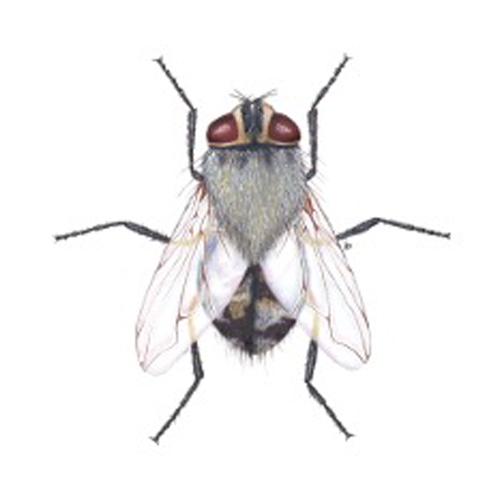
CFs are relatively large (~10 mm) and superficially resemble HFs, but can be distinguished by a broader, darker body, golden thoracic hairs, and a dull checkered abdomen. CFs are not filth-associated and do not reproduce in and around organic waste. Adults are often lethargic indoors, especially during cool temperatures, and may accumulate in attics, wall voids, and other structural spaces, especially near windows during fall and winter.
CF is not understood to be a mechanical disease vector. Large indoor accumulations of dead, desiccated CFs can fragment over time, creating airborne particulates that may exacerbate asthma and allergies in sensitive individuals. Additionally, decomposing CF corpses may serve as a secondary attractant and nutrient source for Dermestid beetles (Coleoptera: Dermestidae), Cockroaches (Blattodea), and even commensal rodents. This initiates a successional chain of opportunistic pest infestations within structural voids.
| Trait | Description |
| Size | ~10 mm or 0.4 in |
| Color | Dark gray to olive thorax & golden hairs |
| Flight | Slow, lethargic (1-2 km/h or 0.6 to 1.2 mph) |
| Activity | Diurnal (day-active) |
| Season | Late summer to early spring (indoors) |
| Reproduction | Places eggs in soil (oviparous) |
| Risk | Indoor allergen and nuisance |
CF larvae are natural parasitoids of Earthworms, contributing to soil ecology by regulating annelid populations. While considered a nuisance indoors, CFs pose no significant risk to public health and do not reproduce within structures.
CF larvae obligately parasitize Earthworms (especially Grey worm, Aporrectodea caliginosa). Grey worm is widespread in temperate soils. Grey worm is a preferred CF host because of shallow burrowing behavior, increasing exposure to CF eggs placed in the soil.
A single female CF can place approximately 100 to 130 eggs over a lifetime. Typically, batches are deposited in moist soil where Earthworms are active. Each egg hatches into a larva that seeks out and parasitizes an Earthworm host, making CFs biologically distinct.
"*" indicates required fields


Mon - Fri : 8 AM - 5 PM | EST