

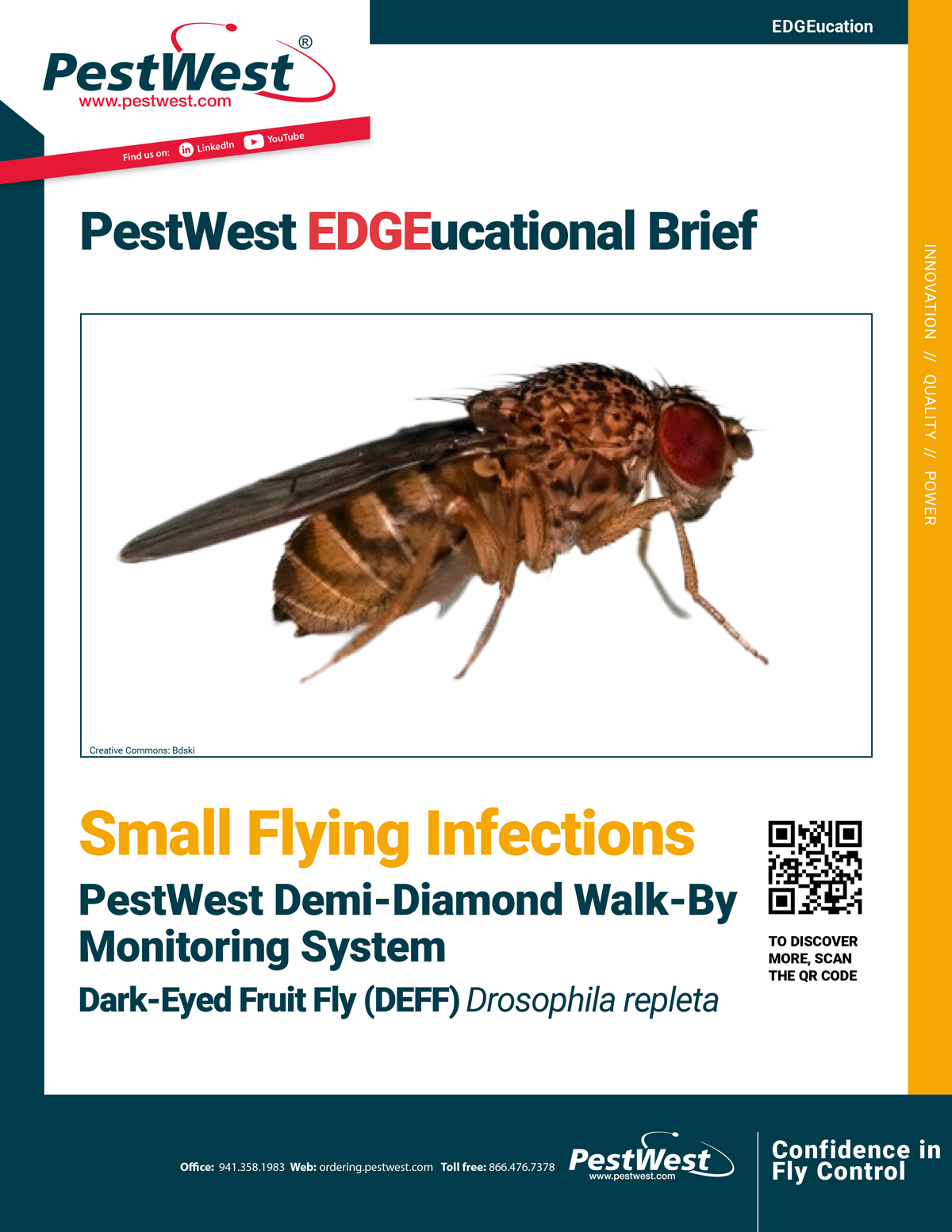
DFs are small, robust-bodied flies (0.5 to 5 mm) recognized by compact build, darting movements and limited flight. Under magnification, wings present shortened costa and reduced crossveins, while preapical dorsal hind tibial bristles are key distinctions. Enlarged hind femora enable short jumps or bursts of movement. Distinguished by run or hop behavior across substrates before launching brief flights.
Estimated time sequence for fly surface behavior.
| Behavior | Estimated Time | Notes |
| Attraction (approach) | 1-4 seconds | Strong orientation to manure VOCs: ammonia, indole, and skatole |
| Landing | Instantaneous | Often lands directly from approach flight |
| Grooming | 2-6 seconds | Cleans antennae, eyes, body, legs, and wings; grooming dislodges particulates |
| Salivation (extraoral digestion) | 1-3 seconds |
Pathogen containing saliva is expressed onto the surface to pre-digest material before feeding |
| Defecation | 1-2 seconds | Often occurs during or after feeding |
| Take-off | <1 second | Departs by walking, hopping, or short flights |
DFs develop in manure, and can mechanically transfer bacteria, protozoa, and helminth eggs. Larvae may ingest and later excrete viable pathogens, adding a digestive contamination pathway.
In forensic entomology, and in the order of succession, Sphaeroceridae are considered secondary colonizers of carrion, decomposing matter, and human remains. DFs have a predictable arrival (often after Blow flies but before other secondary decomposers), which can help refine postmortem interval (PMI) estimates, particularly within sheltered or indoor environments where Blow fly access is limited. Due to small size and thigmotactic behavior, DFs can infiltrate confined spaces such as partially sealed containers, organic build-up filled drains, and crypts. DF presence on remains may also indicate nearby manure, fecal matter, or nutrient-rich organic substrates, useful for crime scene reconstruction.
| Trait | Description |
| Size | 0.5–5 mm (0.02 to 0.2 in) |
| Color | Dark brown to black |
| Flight | Weak, short, erratic flights often interspersed with rapid running or hopping |
| Activity | Diurnal, saprophagous; moist organic sites |
| Season | Year-round in sheltered conditions |
| Reproduction | Places eggs (oviparous) |
| Risk | Mechanical vector and nuisance |
DFs accelerate decomposition of animal waste and other organic matter, contributing to nutrient recycling. In agricultural systems DFs support manure breakdown. However, when in and around sensitive structural environments, DFs are potentially serious contamination events.
| SAFER | Impact |
| S-Safety | Mechanical transfer of manure-borne pathogens to sensitive areas |
| A-Audit risk | Indicator of manure and waste management issues, risking audit impact |
| F-Financial loss | Costs from waste handling corrections, product contamination and disposal, lost revenue, and possible penalties |
| E-Exposure (Brand) | Association with manure and creates strong negative public perception |
| R-Regulatory | Violates food safety regulations and third-party audit standards |
DF emergence indoors is a red flag for waste handling or sanitation failures requiring immediate correction.
Closely associated with manure and decaying organic matter. Fly species presence may result from exploitable resource sites in and around a facility’s legacy equipment and/or infrastructural decay—further indicating declining facility health.
DFs possess multiporous antennal sensilla tuned to detect trace concentrations of manure VOCs such as ammonia, butyric acid, p-cresol, indole, and skatole. These chemical cues are so potent that DFs can orient upwind toward a source from several meters away, even when hidden from view.
VOC sensitivity allows DFs to locate and exploit fresh dung (sometimes within minutes of deposition). In veterinary and forensic contexts, DF quick appearance can serve as an indicator of post-deposition time.

"*" indicates required fields


Mon - Fri : 8 AM - 5 PM | EST