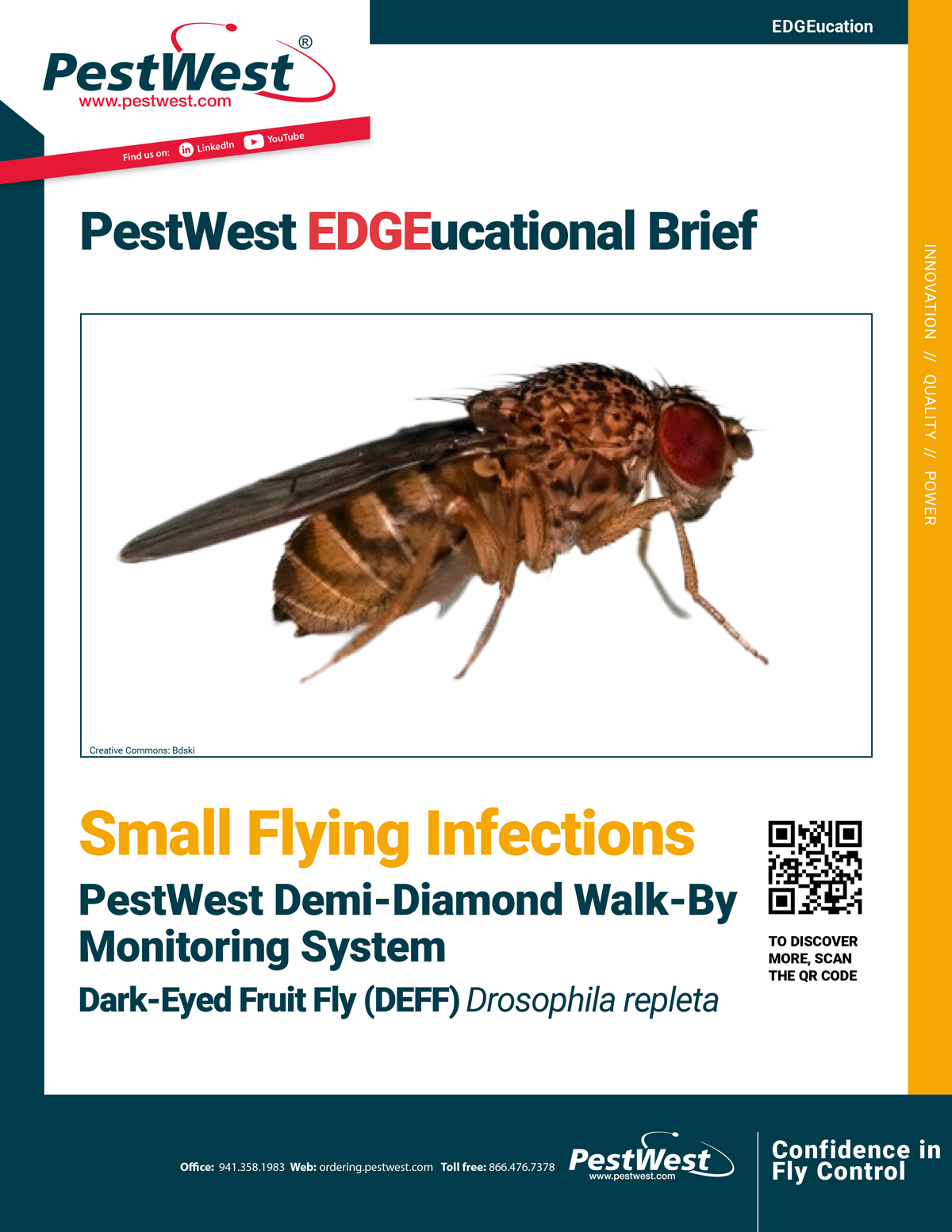
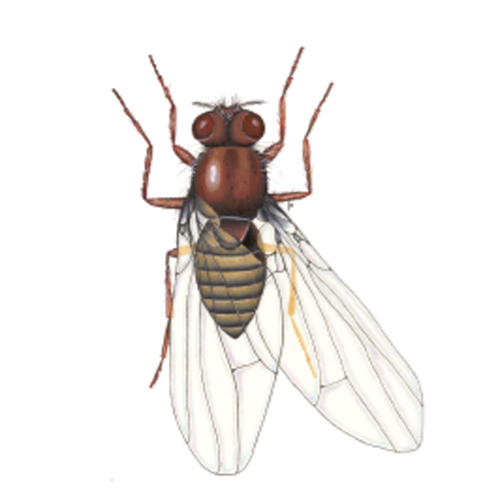
Drosophila spp. are small flies (2 to 4 mm). D. melanogaster possesses distinct red compound eyes and tan body. D. repleta possesses dark compound eyes and brownish body. Species are active around rotting produce, sugary syrups, fermenting liquids, and effluence. Yeast cells express acetate compounds to attract flies for cell translocation and colonization. D. melanogaster and D. repleta fly at 3.6 km/h (2.2 mph), with nutritionally robust adults capable of bursts nearing 5.8 km/h (3.6 mph). This flight behavior enables efficient navigation around fermenting and putrefying substrates (allowing for rapid sensory response in confined environments).
Estimated time sequence for fly surface behavior.
| Behavior | Estimated Time | Notes |
| Attraction (approach) | 1-3 seconds | At 2-3 m source distance, orientation using olfactory & visual cues |
| Landing | Instantaneous | Typically land on target after circling, hovering |
| Grooming | 3-10 seconds | Cleans antennae, eyes, body, legs, and wings; grooming dislodges particulates |
| Salivation (extraoral digestion) | 1-5 seconds | Pathogen containing saliva is expressed onto the surface to pre-digest material before feeding |
| Defecation | 1-3 seconds | Often occurs during or after feeding; fecal droplets may be microscopic |
| Take-off | <1 second | Quick lift-off, often triggered by motion or visual change |
A FF may land, groom, salivate, defecate, and take off, all in under 20 seconds, potentially contaminating a surface in less than 10 seconds. With a wing beat of 175-250 Hz, nearby contaminants can be aerosolized.
| Trait | Description |
| Size | 2–4 mm (0.08 to 0.16 in) |
| Color | Tan (melanogaster) to brown (repleta) |
| Flight | Short, weak, erratic (3.6 km/h or 2.2 mph) |
| Activity | Endophilic, diurnal, persistent in temperature-controlled environments |
| Season | Year-round, peak in summer |
| Reproduction | Places eggs (oviparous) |
| Risk | Poor hygiene indicator species and food contamination |
D. melanogaster and D. repleta serve as decomposers by accelerating the breakdown of organic waste. Notably, D. melanogaster is significant in scientific research. However, in and around sensitive spaces, their presence is a red flag for poor hygiene.
| SAFER | Impact |
| S-Safety | Vectors yeast, mold spores, and pathogens and may contaminate food via regurgitation, feces, and bodily grooming contact |
| A-Audit risk | Presence in small size allows unique access to food production and handling and may result in non-conformance |
| F-Financial loss | May cause product contamination resulting in disposal, lost revenue, and penalties |
| E-Exposure (Brand) | Front of house presence damages customer trust and online brand reputation |
| R-Regulatory | Violates food safety regulations and third-party audit standards in sensitive areas |
Increasing FF presence from reproduction within micro-habitats indicates increasing micro-sanitation lapses.
Flourish in sugary liquids and residues, fermenting materials, and organic film (often in overlooked areas).
“Sugar snakes” refer to sticky, sugary residues (like spilled soda, fruit juice, fermenting beer, and decaying protein) that accumulate in cracks, under equipment, floor drains, floor mats, or mop buckets. What begins as a small spill of soda, juice, or syrup can quickly evolve into a microbial and entomological hotspot.
These sticky residues (known as “sugar snakes”) trap organic debris and foster rapid microbial growth, especially yeasts and bacteria that ferment the sugars into volatile compounds. Fermentation odors attract flies, which place eggs directly in the residue. As larvae feed and mature, the mass accumulates, expanding in size and complexity. The result is a dense, often hidden mass that remains moist at its core, hardens at the edges, and serves as a rich resource site, posing a persistent sanitation and compliance risk in sensitive food-handling environments.

"*" indicates required fields
Mon - Fri : 8 AM - 5 PM | EST