
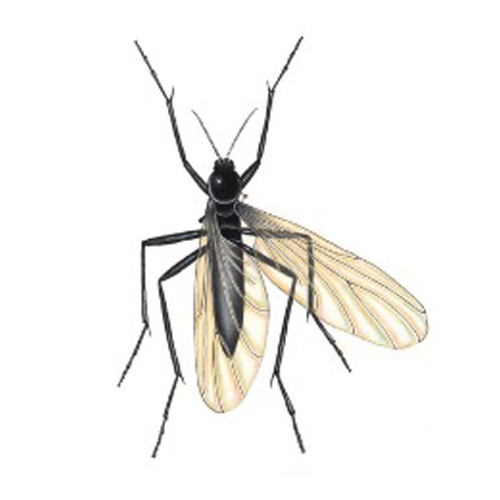
FGs are small (2 to 4 mm), slender-bodied flies with long legs and long, segmented antennae. FGs are delicate as adults, somewhat resembling mosquitoes but proboscis lacking. FGs possesses distinctively long legs and antennae (often longer than the head and thorax combined). Wing venation presents a distinct Y-shaped-fork (key diagnostic feature under magnification). Adults are often observed walking on soil surfaces or nearby structures, rarely flying long distances. Larvae are slender, legless, with a shiny black head capsule (found within moist organic matter, feeding on fungi and decaying plant tissue).
FGs thrive in moist, organic-rich resource sites (potted plant media, greenhouse soils, and mushroom production facilities). Females use specialized hygroreceptor sensilla on their antennae to detect subtle moisture gradients in soil, allowing selection of oviposition sites with optimal humidity. Larvae preferentially colonize actively sporulating fungal colonies over dormant mycelium, likely due to higher nutrient availability. In Bradysia spp., pupae, though generally immobile, can reposition slightly within the soil if disturbed. A rare behavioral trait that may aid in avoiding predation or desiccation.
FGs are primarily considered plant and nuisance pests, but larvae can mechanically vector soilborne plant pathogens such as Fusarium (soil-borne fungal pathogen), Pythium (soil-borne fungal pathogen), and Verticillium (soil-borne fungal pathogen). In and around sensitive environments, FG adults may mechanically transport fungal spores or bacteria from contaminated substrates to clean surfaces.
| Trait | Description |
| Size | ~2–4 mm (0.08 to 0.16 in) |
| Color | Black to dark gray body; clear to smoky wings |
| Flight | Weak; adults hover short distances |
| Activity | Endophilic, structural leaks, near potted plants, moist substrates, elaborate plantscapes, and mushroom production |
| Season | Year-round indoors (persistently moist resource sites) |
| Reproduction | Places eggs (oviparous) |
| Risk | Mechanical vector of plant pathogens, plant root damage, and nuisance |
FGs aid in the breakdown of decaying plant material and recycling of organic nutrients in soil ecosystems. However, in indoor plantscapes, greenhouses, and mushroom farms, high populations can damage plant roots, stunt growth, and promote pathogen spread.
| SAFER | Impact |
| S-Safety | Potential vector for soil-borne pathogens and a nuisance to structural inhabitants |
| A-Audit risk | Presence in production or storage areas signals moisture intrusion issues |
| F-Financial loss | May require costly maintenance repairs or replacements and loss of employee production due to nuisance |
| E-Exposure (Brand) | Nuisance to structural inhabitants and loss of reputation |
| R-Regulatory | May breach pest-threshold requirements in greenhouses, nurseries, and food safety audits |
FGs are small and persistent (determining moisture and resource sites is key to prevention).
Associated with plantscapes, moist soils, organic build-ups, and structural leaks resulting in moisture intrusion.
FGs are strongly attracted to carbon dioxide and high humidity, which can lure FGs toward human exhalations and moist facial secretions. Larvae can survive submersion in saturated soils for several days due to a low metabolic rate and cuticular resistance. FG wingbeat frequency ranges from approximately 150 to 200 Hz, detectable by certain predators, such as Orb-weaving spiders. Innate carbon dioxide orientation response (evolved for finding decomposing organic matter) may cause adults to approach medical patients and medical equipment in sensitive healthcare settings.
"*" indicates required fields


Mon - Fri : 8 AM - 5 PM | EST