
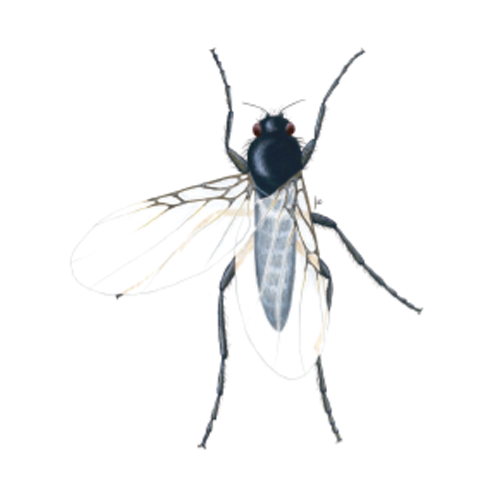
PFs are small (0.5 to 5 mm), and dark-colored with a pronounced arched thorax. Often mistaken for fruit flies, but distinguished by rapid, erratic running behavior rather than immediate flight. Most common species, M. scalaris, thrives in a variety of decaying organic materials, including moist food waste, fungal growth, sewage-contaminated substrates, and carrion. Adults are capable of both short flights and rapid scuttling, allowing adept movement between contaminated sites and sensitive surfaces. Scuttle at 1 to 2 cm/s (0.02 to 0.04 mph) on smooth surfaces, with short bursts up to ~3 cm/s (0.07 mph) over short distances.
Estimated time sequence for fly surface behavior.
| Behavior | Estimated Time | Notes |
| Attraction (approach) | 1-5 seconds | Strong orientation to protein decomposition compounds, and sewage volatiles |
| Landing | Instantaneous | Often lands after short circling flight or directly from scuttling approach |
| Grooming | 3-8 seconds | Cleans antennae, eyes, body, legs, and wings; grooming dislodges particulates |
| Salivation (extraoral digestion) | 1-4 seconds | Pathogen containing saliva is expressed onto the surface to pre-digest material before feeding |
| Defecation | 1-2 seconds | Often occurs during or after feeding; fecal droplets may be microscopic |
| Take-off | <1 second | Quick lift-off, may resume scuttling instead of direct flight |
PFs can complete the entire contamination sequence in less than 15 seconds, while scuttling behavior increases the likelihood of traversing contaminated to sensitive contact points prior to flight.
| Trait | Description |
| Size | 0.5–5 mm (0.02 to 0.2 in) |
| Color | Brown to black |
| Flight | Short; more likely to scuttle rapidly across surfaces (1 to 2 cm/s or 0.02 to 0.04 mph) |
| Activity | Endophilic, diurnal, persistent in warm, humid environments |
| Season | Year-round indoors (persistent resource sites) |
| Reproduction | Places eggs (oviparous) |
| Risk | Mechanical vector, nuisance, and myiasis |
PFs accelerate the decomposition of organic matter and play a role in nutrient recycling. However, in and around sensitive structural environments, en masse PF flushes, linked to carrion and sewage, are serious contamination events. Fly behavior of running across contaminated to clean surfaces allows the efficient mechanical vector of bacteria such as Salmonella and E. coli.
| SAFER | Impact |
| S-Safety | Vectors pathogens from decomposing masses and sewage as well as contaminates food via regurgitation, feces, and bodily grooming contact |
| A-Audit risk | Presence often signals a septic or sewer system failure |
| F-Financial loss | May cause product contamination resulting in disposal, lost revenue, and penalties (also-non-preventative maintenance results in costly repairs to septic and sewer systems) |
| E-Exposure (Brand) | Rapid-onset presence damages customer trust and online brand reputation |
| R-Regulatory | Violates food safety regulations and third-party audit standards |
Increasing PF presence is symptomatic of legacy equipment and infrastructural failures or decreasing facility health.
Known for erratic “scuttling” and strong association with decomposing organic matter and failing effluence sites. Fly species presence may result from exploitable resource sites in and around a facility’s legacy equipment and/or infrastructural decay—further indicating declining facility health.
Phorid flies a.k.a., “coffin flies” can penetrate sealed mausoleum enclosures. Phorid flies can locate mausoleum crypts and sealed caskets by detecting trace decomposition odors that escape through micro-cracks. PF possesses short antennae with olfactory sensilla specialized for decay volatiles such as putrescine, cadaverine, dimethyl disulfide, and indole. An array of odorant receptors and highly sensitive antennal lobes, enable PF to follow micro-scent plumes in still air. A combination of klinotaxis (side-to-side odor sampling), anemotaxis (airflow odor tracking), and small body size, allow Phorid flies to locate, enter, and exploit bodily remains.
"*" indicates required fields


Mon - Fri : 8 AM - 5 PM | EST