
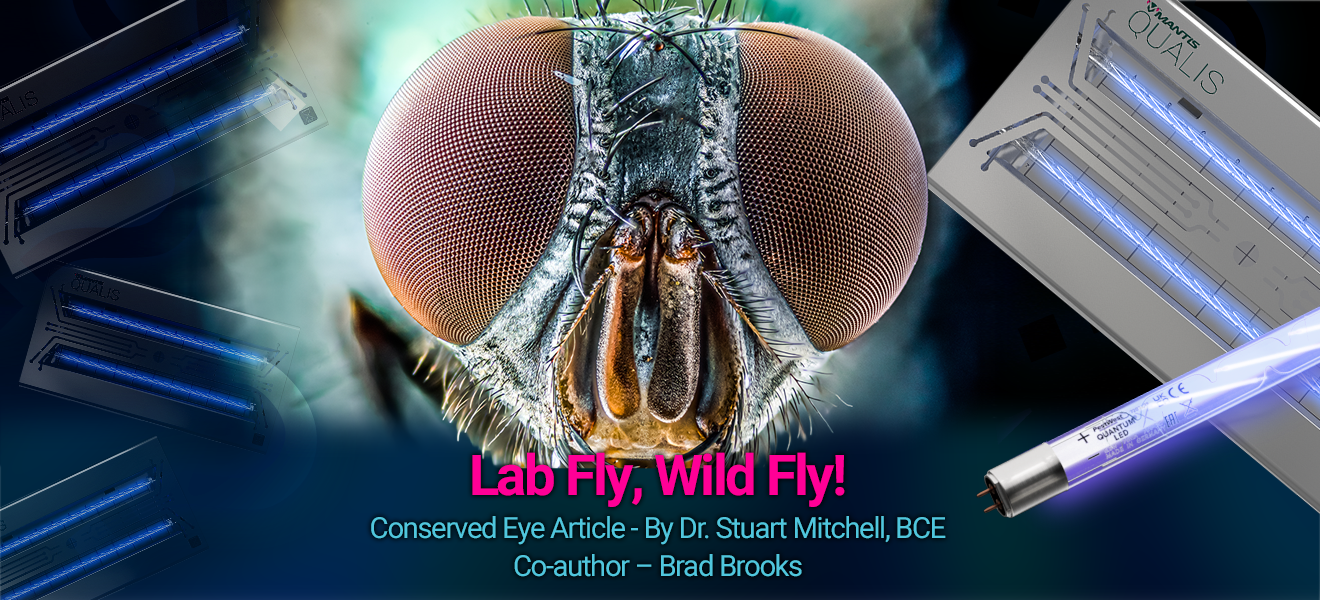
In an independent laboratory study¹, the Qualis with two Quantum X UV-A LED lamps captured an average of 91.2% of released house flies in three hours in a white test room. Put that same system in a dumpster room and the instinct is to dismiss the number as “just lab flies.” Applying Occam’s Razor, the simplest explanation is also the most cautious: lab and wild house flies share the same basic visual hardware, broadly conserved across strains, with field differences driven by environment, not by a different eye.
At the level of a single ommatidium, lab and wild Musca domestica are understood to share the same basic design. Each facet contains eight photoreceptors. The outer receptors, R1 through R6, contribute strongly to luminance and motion vision and, in flies, are associated with a UV-sensitizing mechanism (Kirschfeld et al., 1977; Stark et al., 1979)2,3 that increases ultraviolet sensitivity. The inner receptors, R7 and R8, in Dipterans including Musca and Drosophila, contribute to spectral discrimination, with UV-, blue-, and green-sensitive channels reported in Dipteran eyes. For insect light trap attraction, the important point is not about a unique “lab eye” or “wild eye,” but that the underlying photoreceptor architecture is conserved across house fly populations.
That underlying visual organization appears to be stable across strains. A lab fly reared on an artificial diet and a wild fly on a dumpster diet are both expected to develop the same broad classes of photoreceptors reported for M. domestica and the same general spectral sensitivities typical of the species. Rearing conditions may affect vigor, behavior, and immediate light adaptation state, but are not expected to alter photoreceptor classes or peak sensitivities.
This helps explain why older wavelength work still matters to insect light trap system design. Classic studies on fly phototaxis reported strong behavioral sensitivity in the near-UV, including around the fluorescent 365 nm line, and later physiological (e.g., electroretinogram) work likewise identified prominent UV sensitivity in fly eyes. The Qualis Quantum X LED lamps, engineered to 365 to 370 nm, are therefore positioned in a wavelength range that is well aligned with known fly UV responsiveness. Whether a fly came from a rearing colony or a disgusting dumpster, the incoming UV photon is still being sampled by the same general visual system.
This does not mean that every lab result will translate directly to every field setting. Wild flies experience brighter and more variable environments, competing odors, airflow, resting surfaces, and alternative light sources. Additionally, light adaptation can change sensitivity on short time scales. Even so, if an insect light trap emits strongly in a wavelength range to which house flies are known to respond, the conserved visual system gives a reasonable biological basis for expecting attraction in both lab and field populations. The practical question is not whether wild flies have a different eye, but how much the surrounding environment influences their response.
That is why the Qualis 91.2% result can matter beyond a brochure claim. First, as a controlled test result, it suggests that the system can achieve high capture under defined conditions when its output matches known house fly visual sensitivity. Second, as a flying insect management tool, it provides a repeatable benchmark that can be compared across settings. Because the basic visual architecture of house flies is expected to be conserved across populations, differences in catch are more reasonably interpreted as differences in environment, pressure, placement, maintenance, or competing stimuli than as evidence of a fundamentally different eye.
Lab fly, wild fly, conserved eye; same broad visual plan, same general UV responsiveness. The Qualis concept is persuasive because it is engineered around visual features that appear to be conserved in house flies, not around a response unique to one colony. On that basis, the lab data should be read as meaningful evidence of potential performance under favorable conditions, while recognizing that field outcomes will still vary with environment. The conserved eye supports a predictable biological response, even when the exact catch number changes from one environment to another. Field capture performance will vary with sanitation, legacy equipment and infrastructural failures or decreasing facility health, competing light, and ILT placement. Ultimately, a photon interacts with the same retinal chromophore in the same photoreceptive architecture.
1Independent laboratory testing by i2LResearch Ltd. demonstrated that the Qualis captured an average of 91.2% of released Musca domestica over a 3-hour test period under controlled laboratory conditions (Study Code 21/335, 2021).
2Kirschfeld, K., Franceschini, N., and Minke, B., 1977. Evidence for a sensitising pigment in fly photoreceptors. Nature, 269(5627), pp. 386–390.
3Stark, W.S., Stavenga, D.G., and Kruizinga, B., 1979. Fly photoreceptor fluorescence is related to uv sensitivity. Nature, 280(5723), pp. 581–583.
Disclaimer: This content does not constitute professional, legal, medical, or regulatory advice of any kind and does not replace independent judgment.