
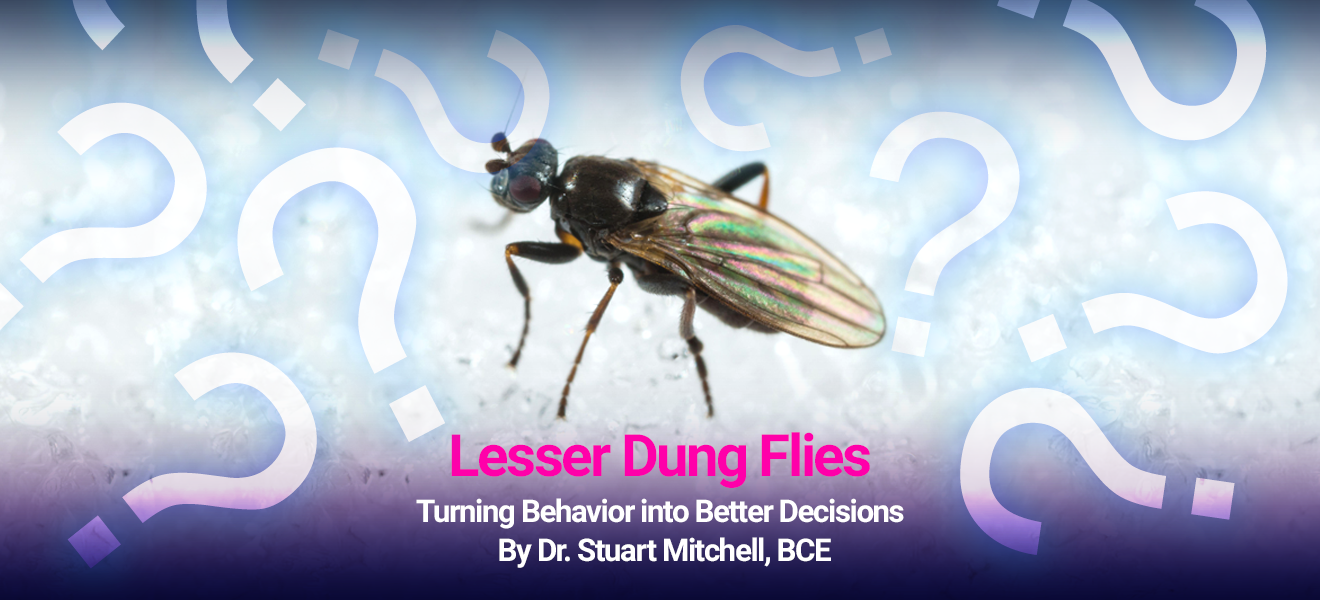
In and around sensitive facilities – the presence of Lesser dung fly (LDF) – (Family Sphaeroceridae) is not just a nuisance – it is a signal. Small, fast, and quite often overlooked – LDFs convert concealed sanitation failures into visible biological activity. Understanding behavior through the lens of Attraction → Landing → Capture → Retention → Data → Decisions allows pest management professionals (PMPs) to move from reaction to precision.
Attraction - Chemistry Drives the First Move
LDFs are chemically guided insects. Using highly sensitive antennal receptors – they detect volatile organic compounds (VOCs) such as ammonia, indole, skatole, and butyric acid – signature emissions of manure and decomposing organic matter. Attraction can be rapid, directional, and efficient. LDFs can orient upwind and may locate suitable resource sites quickly – sometimes arriving within minutes of fresh waste deposition under favorable conditions. In structural environments – concealed organic build-ups from legacy equipment and decaying infrastructure can act as invisible attractants.
Landing - Contact Begins the Risk
Once a LDF arrives – it often makes rapid surface contact. LDF’s compact morphology and short-flight behavior support quick landing and movement across surfaces. This moment represents the transition from environmental presence to contamination potential.
Capture - The Critical Control
Upon landing – LDFs often groom and may express saliva (extraoral digestion) and defecate – which can contribute to mechanical transfer of microbes/contaminants from filth sources to sensitive surfaces. Responsive to near-UV/UVA wavelengths (typically ~350–370 nm) – which are leveraged in insect light traps – such devices – when placed according to best practices are an influential and critical diagnostic tool. Capture is not just removal – it is interruption of LDF behavior.
Retention - It Isn’t About Attraction Alone
LDFs are agile, capable of rapid running, hopping, and escape. Retention is critical. A trap that attracts but fails to retain is in operational failure mode. It isn’t about attraction alone – it’s about ensuring that once flies land – they cannot leave.
Data - The Glue Board Language
LDFs are not random captures – they are diagnostic indicators. Adults display thigmotaxis (preference for tight contact with surfaces) and cluster in protected crevices. Due to compact morphology and thigmotactic behavior – LDFs often indicate localized or concealed rich resource sites rather than broad-area infestations.
LDF presence signals organic waste accumulation, moisture-rich microhabitats, and facility health deficits. When a PMP is glue board savvy – an insect light trap glue board is a fly behavioral corridor bulletin board. A glue board is a robust information center – not a disposal tool.
Decisions - From Detection to Correction
Effective pest management is not about killing flies – it is about eliminating the conditions that produce them. LDF activity should trigger prompt sanitation audits (e.g., inspection of floor drain systems, grease traps, wet mops, slurry under equipment, leaking condensate lines, dumpster pads, and other rich waste zones).
Bottom Line
LDFs transform invisible sanitation failures into visible biological signals. When understood through this framework – they turn behavior into better decisions. In modern pest management, the goal is not just control – it is clarity.
For an even better understanding of LDF behavior and control – connect with PestWest at 941.358.1983 or drop a line at customerservice@pestwest.com.