Rheology: A Sticky Situation By Dr. Stuart Mitchell, BCE
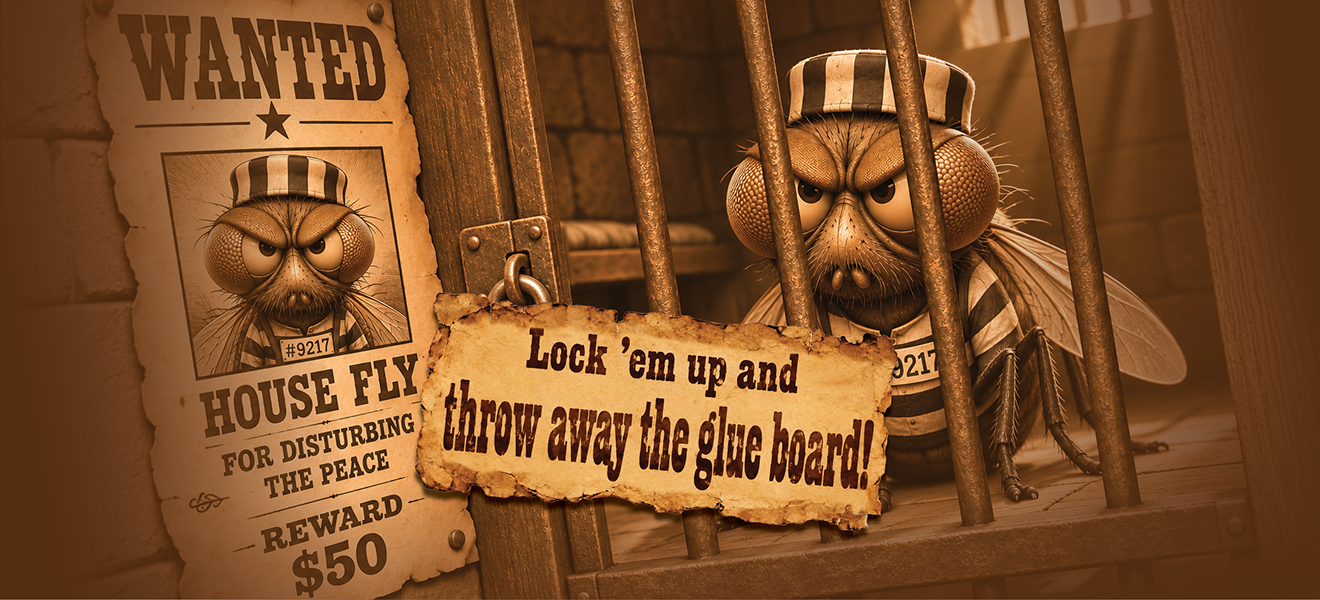
Attracting a pestiferous house fly is only half the challenge. Capturing it – and ensuring it remains captured – is where glue board adhesive science becomes essential.
In insect light traps (ILTs) – ultraviolet-A (UVA) light stimulates insect photoreceptors – influencing positive phototaxis (directed movement toward the UVA light source). But once a fly contacts the glue board – another science takes over – rheology.
Rheology describes how materials flow and deform under applied forces. A glue board pressure-sensitive adhesive (PSA) exhibits non-Newtonian viscoelastic behavior – combining liquid-like flow with solid-like elastic resistance. Their mechanical responses depend on temperature, deformation rate, and time.
Effective flying insect capture requires the right balance of adhesive viscosity, elasticity, and cohesive strength. Much like the Goldilocks principle – not too soft – not too firm.
An excessively firm adhesive may inadequately wet the insect’s tarsi (feet) and cuticle (outer-exoskeleton) – limiting initial adhesion. Conversely – an overly soft adhesive may deform excessively – potentially compromising retention.
Successful flying insect capture requires sufficient adhesive flow to establish insect contact – followed by mechanical resistance capable of withstanding vigorous insect escape attempts.
Creep, shear, and peel are three significant adhesive concepts. Creep describes gradual adhesive deformation under sustained stress. Controlled deformation can assist adhesion – but excessive creep may compromise flying insect retention.
Shear resistance opposes forces parallel to the adhesive surface as a fly pushes, twists, or struggles sideways.
Peel resistance opposes progressive separation from the adhesive interface when a fly attempts to lift its legs or body. Unlike perpendicular pull-off – peeling involves progressive detachment.
Together – these characteristics influence initial fly immobilization, energy dissipation, struggle-induced fatigue, and long-term retention.
PestWest Quantum® X LED filament technology and the specialized Gray Matrix LED glue board illustrate the importance of matching UVA technology with adhesive performance. This is where Quantum® X LED technology meets adhesive science.
The Gray Matrix LED glue board possesses pressure-sensitive adhesive – distributed across approximately 955 cm² or 148 in² of adhesive capture area. The adhesive possesses perpendicular detachment resistance.
Gray Matrix LED glue board Safety Data Sheet (SDS) identifies a light stabilizer which helps protect adhesive polymer materials against UV-induced degradation.¹
In independent laboratory testing – i2L Research Study No. 20/366 reported a 33.8% increase in house fly (Musca domestica) capture when the Gray Matrix LED glue board was used in the Quantum X LED-equipped Mantis® Qualis compared with a conventional fluorescent UVA glue board tested in the same LED system.²
In a separate efficacy evaluation – i2L Research Study No. 21/335 demonstrated that the Mantis® Qualis system – equipped with two Quantum X LED filament lamps and Gray Matrix LED glue board – captured an average of 91.2% of released house flies within 180 minutes – across eight replicates under controlled laboratory conditions.³
These results demonstrate the importance of considering insect visual behavior, UVA emission, glue board adhesive characteristics, and capture performance as interacting components of an integrated ILT system.
The future – one adhesive – multiple technologies? Historically warmer fluorescent and cooler LED ILTs have benefited from adhesives suited to their respective operating environments. The Goldilocks principle.
Advances in polymer rheology may enable next-generation adhesives with a broader viscoelastic operating window – maintaining effective wetting, controlled creep, and resistance to shear, peel, and flying insect detachment or escape across both technologies. However – equivalent cross-platform performance requires controlled comparative testing – not assumptions based solely on adhesive formulation, thickness, or material measurements.
For pest management professionals – understanding adhesive rheology reinforces the importance of selecting scientifically validated glue boards that deliver effective capture and reliable retention under actual operating conditions.
Because it isn’t about attraction alone – it’s about ensuring that once flies land – they cannot leave!
References
- PestWest USA LLC. (2026). Gray Matrix Glue Board for LED: Safety Data Sheet. Product Code: 135-000226.
- i2L Research. (2020). Efficacy evaluation of multiple trap systems against houseflies (Musca domestica) under laboratory conditions. Study No. 20/366.
- i2L Research. (2021). Efficacy evaluation of the Chameleon Qualis fly trap against houseflies, Musca domestica, under laboratory conditions. Study No. 21/335.