
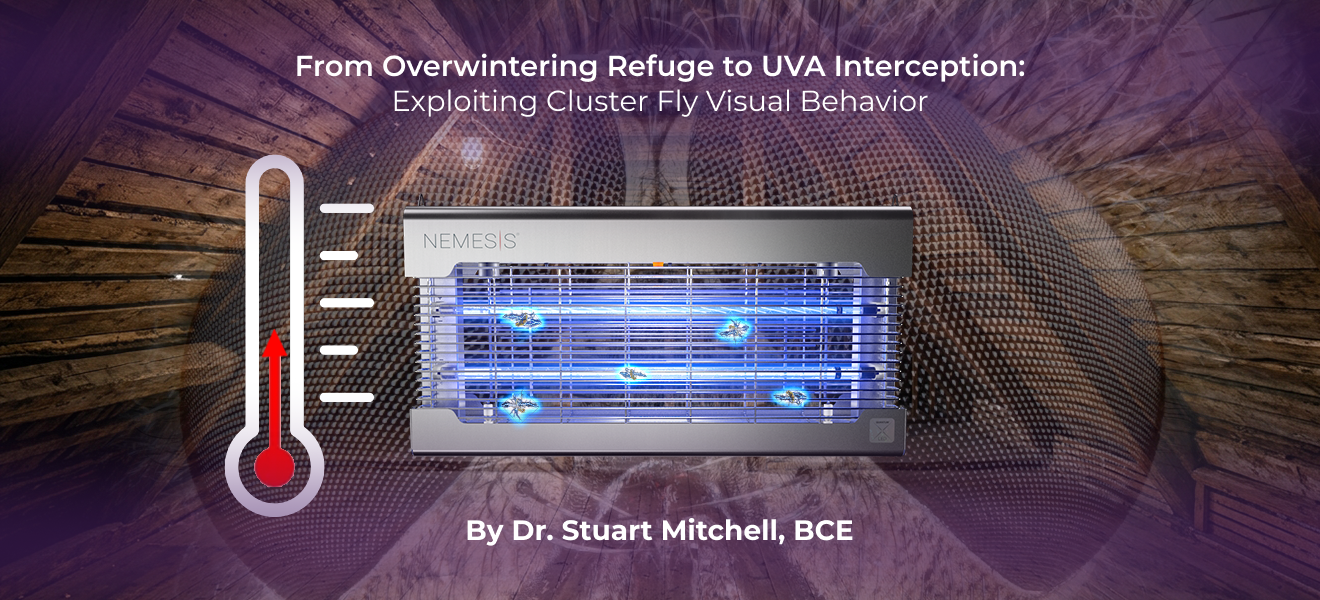
Cluster flies are unusual structural invaders. Unlike filth flies – they do not reproduce indoors. Instead – adults enter structures in late summer and autumn and seek protected overwintering sites in attics, wall-voids, upper stories, and other infrastructural spaces. When temperatures rise during sunny winter periods or spring emergence – flies in diapause may become active and migrate through the structure toward illuminated spaces. That movement creates an opportunity for biologically informed interception.
Historical research on Pollenia rudis describes a temperature-dependent response to light. DeCoursey1 reported adults as negatively phototropic below approximately 50°F (10°C), positively phototropic above that temperature, and positively thigmotropic at lower temperatures. These observations offer a plausible explanation for why flies occupy dark – confined overwintering sites as temperatures decline and later move toward illuminated areas as conditions warm.
For the PMP - the practical message is straightforward - intercept the cluster fly as it transitions from structural refuge to visually directed moment.
The Nemesis® X provides a beneficial tool for this application. Its Quantum® X LED filament lamps emit 370 nm UVA with 360° light distribution – while approaching flying insects encounter a 4,000 V electrocution grid. The system measures 12.3 in. (31.2 cm) high x 24.3 in. (61.6 cm) wide x 5.2 in. (13.2 cm) deep and weighs 18.7 lbs. (8.5 kg). The Nemesis® X instructions for use (I4U) provide a cluster fly configuration option in which the catch tray can be removed – allowing large numbers of electrocuted or neuro-depolarized flies to fall into a separate collection container.
Placement should align with the infrastructure. For cluster fly interception – ceiling suspension can be particularly advantageous because overwintering populations frequently occupy upper structural spaces. The Nemesis® X is designed for ceiling suspension as well as wall mounting – and its relatively compact 5.2 in. (13.2 cm) depth allows it to be positioned within suitable structural areas while maintaining exposure to the expected cluster fly flight corridors. Non-corroding suspension hardware and the supporting structure must be capable of safely carrying the required 35.2 lbs. (16 kg) load and the system must hang level.
Potential interception locations may include accessible attic bays, upper structural corridors, suspended-ceiling spaces, and transition zones between suspected overwintering refugia and occupied interiors – provided each location meets the I4U environmental, electrical, access, and structural requirements. Nemesis® X placement should intercept movement before flies disperse throughout the structure while minimizing competition from windows, daylight, and strong artificial lighting.
Infrastructure suitability is equally important. The Nemesis® X carries an IP20 rating – the first digit indicates protection against solid objects larger than 12.5 mm (½ in.) – and the second indicates no protection against water. Accordingly – the system requires a dry indoor location and should not be treated as protected against substantial dust exposure or water/moisture. The I4U states that it should not be used outdoors or in barns and stables.
An attic or ceiling void should not automatically be considered an acceptable space simply because cluster flies are present. The space to be protected must be assessed for Nemesis® X suitability. The space must be dry, accessible, structurally suitable, and free from hazardous-location (HazLoc) conditions.
Electrical access must also be considered when selecting confined-space locations. The Nemesis® X operates from 110 V or 220-240 V power – and any power-cord extension must be performed by a licensed electrician. In best practice – installations in attic bays, ceiling voids, and similar infrastructural spaces should comply with applicable electrical and building codes and any site-specific requirements.
During heavy cluster fly emergence the electrocution grid and collection container require frequent inspection because excessive accumulation of cluster flies can become a potential fire risk and a food source for scavenger pests.
The broader IPM principle remains essential – exclusion helps prevent invasion – while strategic UVA interception targets cluster flies that have already entered the structure. When structural exclusion is combined with intelligently positioned Nemesis® X interception – the flies’ documented movement toward light under warmer conditions becomes a significant part of the management strategy.
¹ R. M. DeCoursey, “A Bionomical Study of the Cluster Fly Pollenia rudis (Fab.) (Diptera, Calliphoridae),” Annals of the Entomological Society of America 20, (1927): 377.