
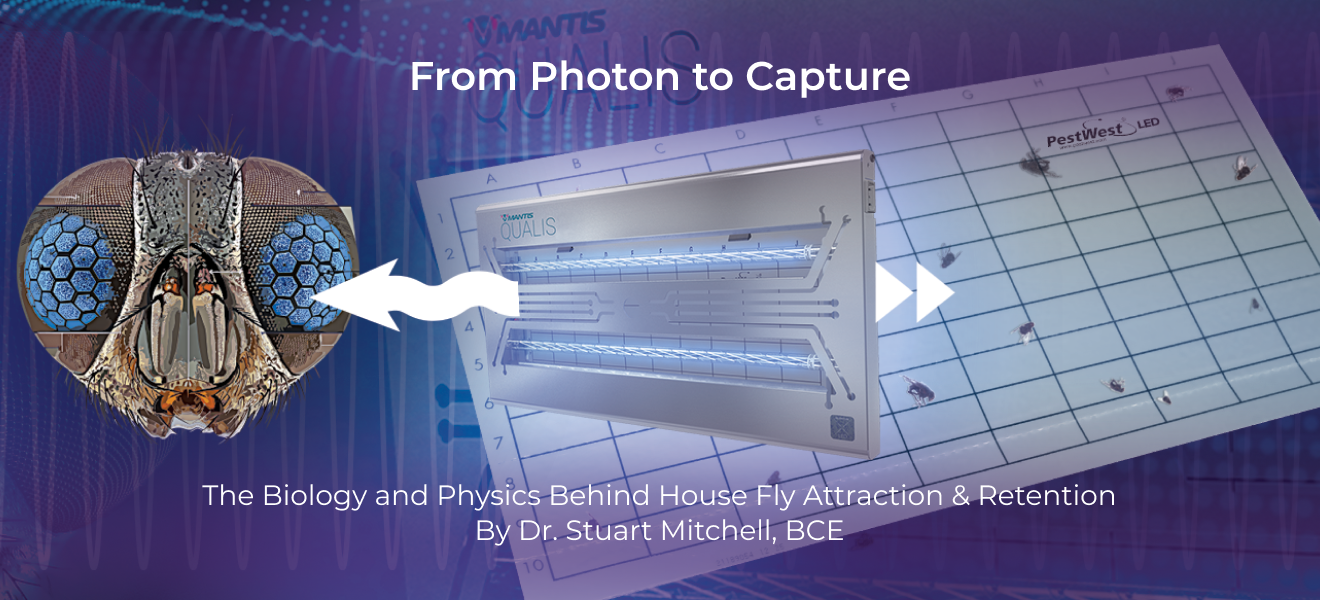
An insect light trap does not capture a fly simply because ultraviolet light is present. Capture is the endpoint of a biological, behavioral, and physical sequence that begins when electromagnetic energy enters the fly’s visual environment and ends when the insect becomes mechanically restrained on an adhesive surface.
For the house fly, Musca domestica, that sequence can be considered as follows:

The PestWest Quantum® X LED filament lamp provides a useful starting point. It features a rated peak wavelength of 370 nm – rated UVA irradiance of 120 mW/m² at 1 m, and broad angular emission pattern. These characteristics help create a near-UVA emission field that a flying insect may encounter from different positions and orientations within an indoor environment.
For the fly – irradiance is only the physical stimulus. It must first become biological information.
When UVA photons reach the compound eye – light-sensitive rhodopsins within photoreceptor cells absorb that energy. In dipteran insects, this initiates a G-protein-dependent phototransduction cascade involving phospholipase C and light-sensitive TRP-family ion channels. The result is a change in photoreceptor membrane potential – electromagnetic radiation has effectively been converted into an electrical signal that the nervous system can process.
House flies possess visual receptors sensitive to near-ultraviolet wavelengths. Neural processing of signals from the compound eyes can influence orientation and locomotion – producing positive phototaxis toward an attractive light source. Importantly – the fly does not perceive a lamp specification such as Watts or mW/m². It encounters a spatially structured visual stimulus influenced by wavelength, irradiance, distance, lamp geometry, device design, reflections, competing illumination, and its own position in space.
This distinction is reflected in an i2L Research study1. The installed Chameleon® aka Mantis® Qualis produced a measured UVA output of 0.06 W/m² at 1 m – which remained consistent throughout eight replicates. Under 300-600 lux indoor lighting – 100 house flies were released during each replicate. Fly capture increased progressively from 22.8% at 30 minutes to 59.7% at 90 minutes and 91.2% at 180 minutes. The progressive capture curve illustrates an important principle – UVA does not capture the fly – it initiates and sustains sensory and behavioral processes that increase the probability of contact with the specialty glue board capture surface.
At contact – the science changes from neurobiology to rheology.
The Gray Matrix LED glue board uses a soft pressure-sensitive adhesive (PSA) applied at a specified coat weight over a defined capture area. A PSA must be sufficiently compliant to wet and conform to contacting portions of the fly’s tarsi, setae, and cuticular surface while retaining enough cohesive strength to resist withdrawal during the fly’s escape efforts.
This balance is the essence of adhesive viscoelasticity. Viscous behavior permits deformation and intimate surface contact – elastic and cohesive behavior resists separation. As a struggling fly places additional legs, wings, or body surfaces against the adhesive – contact surface area can increase and movement becomes progressively restricted.
Thus – effective ILT capture is not one event but an integrated system. The UVA field stimulates the insect – its nervous system converts light into behavior – and the engineered adhesive converts contact into retention.
Phototransduction reads the UVA signal – positive-phototaxis chases it. From photon to capture – every stage matters.
Reference: 1Chameleon Qualis i2L Study 21/335, pp. 1-14.