
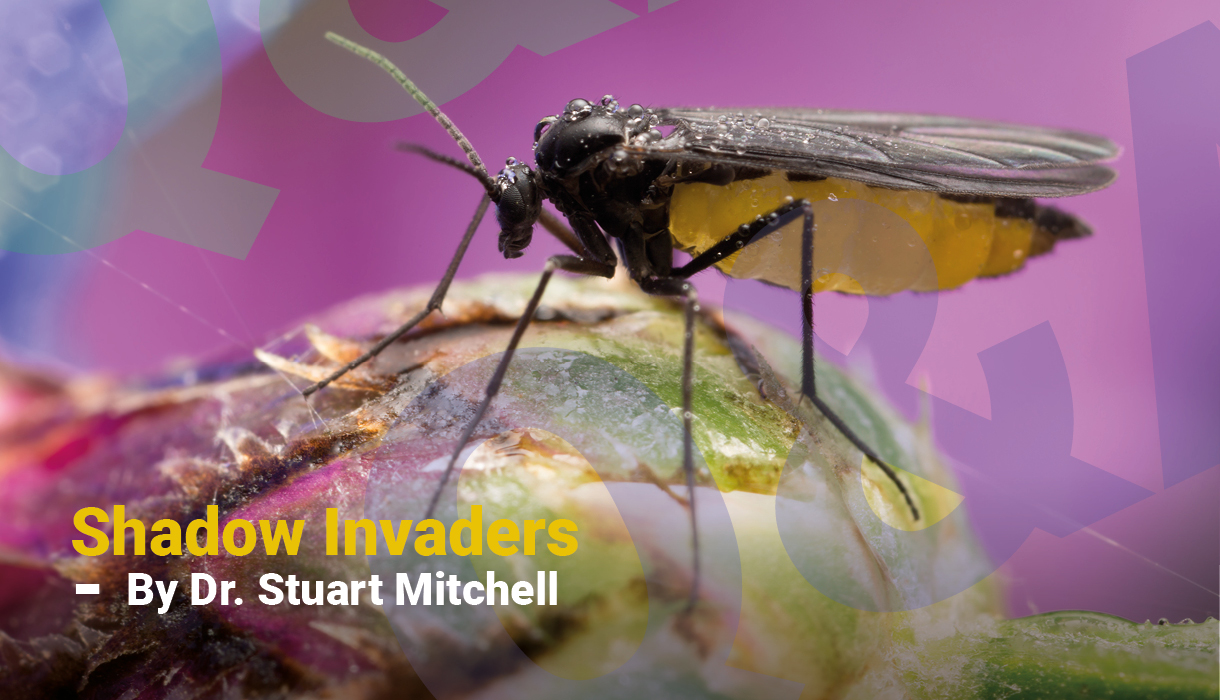
What is a Fungus gnat?
The Darkwinged Fungus gnat (aka: Fungus fly and Mushroom fly) is a fascinating insect classified in the Family Sciaridae. Derived from the Latin, “Sciaridae,” meaning “shadowy” or “dark-colored.” Suitably reflecting the enigmatic nature of these flies that flourish in moist, organic-rich settings.
What do Fungus gnats look like?
Adults are small and delicate (~1/16″–1/8″), dark brown to black, with a mosquito-like appearance. Antennae are long and multi-segmented (~14-16 segments). Legs are long and slender and wings are smoky gray with reduced venation.
Compound eyes often contiguous in males (more separated in females). Ocelli present. Weak fliers – short, erratic and remain close to source habitats.
Larvae are legless with a translucent to whitish, cylindrical body and a distinctive shiny black head capsule. Move via peristaltic motion.
Commonly found in moist, organic-rich media (e.g., potting soil, decaying plant material, fungal growth).
Undergo complete metamorphosis (egg → larva [4 instars] → pupa → adult). Development is closely tied to moisture and microbial activity. Larvae feed upon fungi, algae, and decaying organic matter (microbially mediated substrates).
Presence = moisture + organic buildup + microbial-fungal activity. Control starts with correcting the environment – not chasing the adults.
Do Fungus gnats bite?
Breathe a sigh of relief as Fungus gnats neither bite nor sting. Although, when indoor gnat flushes occur, the human annoyance factor is high.
Are Fungus gnats harmful?
The Fungus gnat diet primarily consists of fungi, decaying organic matter, and occasionally plant roots. Such feeding may harm houseplants.
As an indoor annoyance, free-ranging adult Fungus gnats are sometimes attracted to light fixtures, television and computer screens, and facial secretions. Additionally, dust-borne dead adult Fungus gnats may exacerbate allergies and asthma. Albeit low, there’s a potential risk of transporting pathogens from funky fungi to your succulent salad.
Where do Fungus gnats come from?
Fungus gnats thrive in environments abundant in moisture and rich organic material. They are found around fungal growth in greenhouses, mushroom farms, leaky flat roofs, dumpsters, rotting wood, animal excrement, bird droppings, and atrium potted plants. Adults use a compact, multi-sensory system to locate habitats. Antennae possess chemosensory sensilla that detect fungal and decay-related VOCs. Hygroreceptors sense humidity gradients that guide toward damp microenvironments. Mechanosensory hairs respond to air movement and surface cues. These systems steer adults along odor and moisture gradients to optimal sites for survival and egg placement.
How to get rid of Fungus gnats on house plants?
Fungus gnats in and around houseplants can be reduced or eliminated through proper cultivation or plant care. Maintain plant vitality through a few good practices.
- Watering: Understand the specific water needs of plant species. Overwatering is a common issue. To prevent water accumulation, ensure plant pots have drainage holes and capture trays.
- Light: Place plants within suitable light conditions according to needs.
- Soil: Use the correct soil type for each plant. Repot when necessary to provide fresh nutrients and prevent compaction.
- Temperature and humidity: Maintain a stable temperature and humidity level. Consider the natural habitat of the plant species.
- Fertilization: According to the plant’s growth phase. Being careful not to over-fertilize.
- Pruning and cleaning: Regularly prune dead or yellowing leaves. Clean dust-off leaves ensure proper growth and health.
- Pest control: Prevention is key, walk-by-monitor for evidence of pests. Address infestations promptly using appropriate methods.
- Proper pot: Ensure each plant is within the correct type and size pot.
- Spacing: Provide adequate space between plants to promote air circulation, which may prevent the spread of insect infestations and diseases.
How to control Fungus gnats?
- Remove moist, decaying organic matter
- Repair structural leaks (especially in flat roofs)
- Keep dumpsters and trash receptacles clean
- Utilize numerous glue board UVA light traps
- Use LED electrocution systems for fecund Fungus gnat situations – which provide quick gnat knock down and copious capture capacity
This shadow invader is unmasked. Need more information regarding the enigma of the gnat? Consult with PestWest at 941.358.1983 or message us at customerservice@pestwest.com.
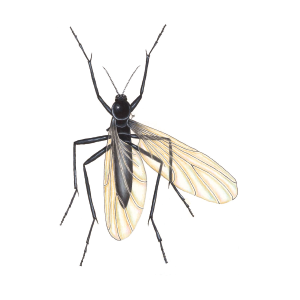
Mushroom/fungus fly
Sciara thomae
Features
Small insects, wingspan 14-15mm. Black head, thorax and abdomen. Thorax has humped appearance.
Control
Chameleon® sticky traps are a very effective step in controlling mushroom flies.
Please click on the image to download “Fly ID”